This is the start of a series—currently, one—but who knows where it might lead. Plugins are big business. If you don’t have the latest trendy plugin, you can get out of my kitchen—at least, that is the attitude that sometimes prevails in the audio world.
But plugins are just tools. If you have no skill, talent, or idea what you’re doing – they won’t save you. They might make it a little better. More plugins do not mean a better mix or a better mix engineer.
With my self-important spouting out of the way, I have decided to look at various plugins available. I will primarily use AAX for Pro Tools, as that is my DAW of choice, but who knows, I may later wander into the unknown jungle that is VST.
All that being said, the first ‘plugin’ I am going to look at is not even a plugin! “Rob what are you doing? Leading us down this plugin rabbit hole, just to tell us the software your going to look at is not even a plugin. I just spilt my tea reading that, and not only that I spilt it down the rabbit hole. Oh well, at least I know what I’m having for Sunday dinner!”
Hey, what can I tell you? I like surprises.
Being serious for one moment, the software I am going to talk about here is Re: Cycle from Digital Brain Instruments.
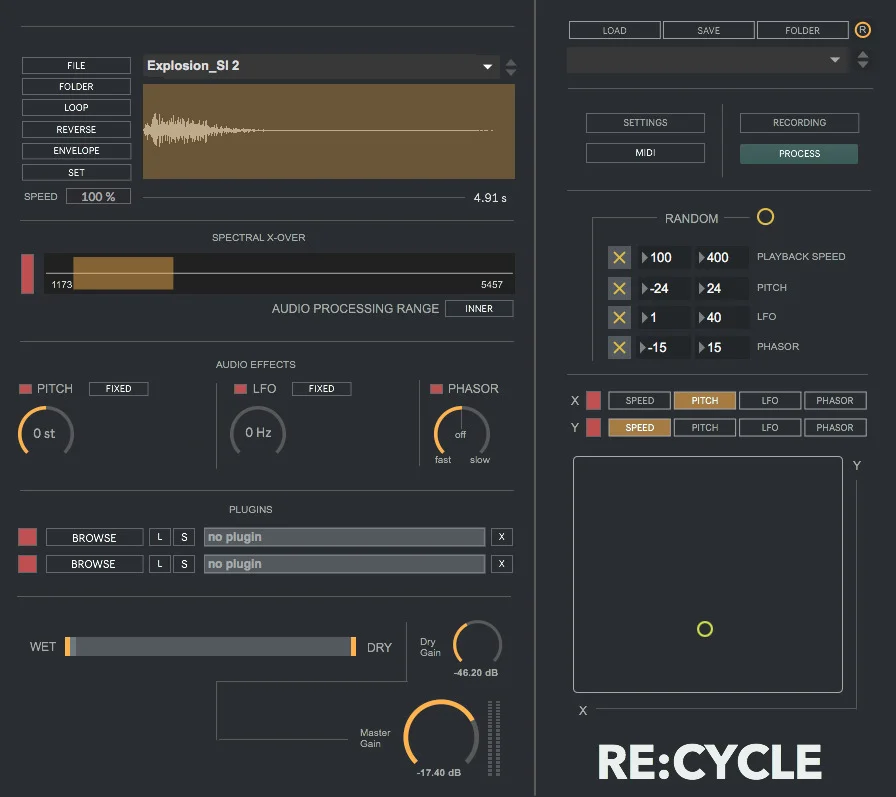
Have you ever looked at your sound libraries and thought, “There’s got to be more to you than this”? Enter Re:Cycle, a standalone audio software that’s essentially a creative mad scientist for your existing sound libraries. Developed by the folks at Digital Brain Instruments, it promises to take your samples and breathe new life into them. It’s weirdly satisfying.
Installing Re:Cycle is refreshingly straightforward—no activation faff, just install and go. Whether you’re a Mac or Windows user, it’s all laid out for you. The interface, while not winning any beauty contests, is intuitive enough to make you feel like you’ve got it all under control.
Re:Cycle lets you load your audio files (WAV, AIFF, or MP3), tweak them in real-time, and transform them into something completely unrecognisable—sometimes intentionally, sometimes accidentally (the randomiser is brilliant chaos). The spectral crossover and envelope designer are particularly fun to play with, giving you control over everything from frequency range to amplitude. Need your sample to sound like it’s coming from the other side of a haunted cave? It’s got you.
There’s also an XY pad for the hands-on types, MIDI support if you want to integrate your favorite controller, and built-in recording for capturing your Frankenstein-like creations in pristine quality. The pièce de résistance? The pitch-shifting and LFO tools that make it feel like your samples are alive and breathing.
If you’re a sound designer, composer, or just someone who likes to fiddle with audio until it doesn’t resemble its original form anymore, Re:Cycle has you covered. It’s particularly handy for anyone working in post-production or game soundscapes. And if you’re not convinced, the random generator will make you a believer—it’s like an over-caffeinated assistant with zero inhibitions.
It’s not all smooth sailing. The preset manager, while functional, could use a UX glow-up. And if you’re working on a screen with less-than-stellar resolution, you might find yourself squinting at times. But hey, these are small potatoes when the software is capable of such sonic wizardry.
The Verdict
Re:Cycle doesn’t just let you remix; it lets you reimagine. It’s like handing your sound libraries a double espresso and watching them take on a whole new personality. For sound professionals, this is a no-brainer addition to your toolkit. For the rest of us, it’s a fantastic excuse to play mad scientist with your favorite audio clips.
So, grab your headphones, load up some samples, and let Re:Cycle do its thing. Just don’t blame us if you spend hours obsessively tweaking that one sample—it’s addictive.